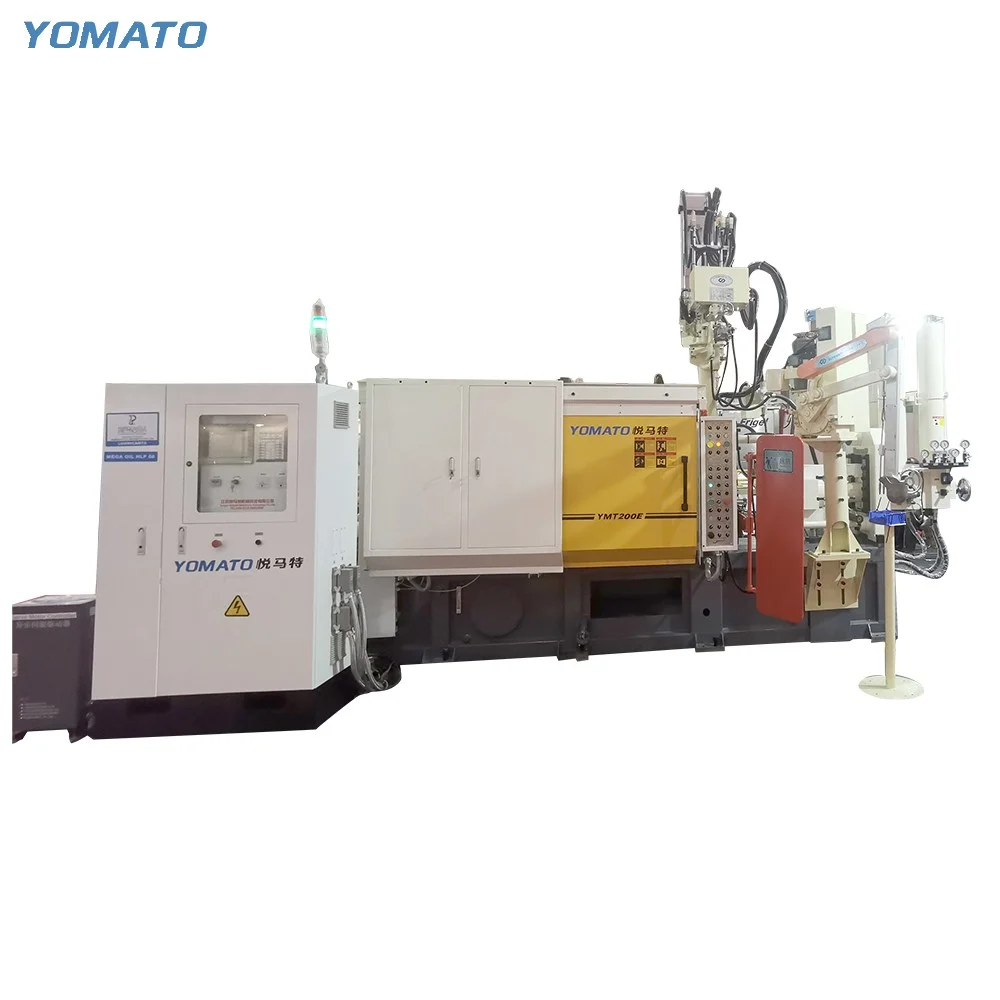
Use it to read the actual force, mounting and movement fields before exploring a machine family in detail. The tables keep model-specific values together, so you can distinguish a machine’s mechanical envelope from its furnace and peripheral package.
Pressure Die Casting Machine Directory
High-pressure die casting, or HPDC, includes different metal-feed arrangements. NADCA’s hot-chamber explanation describes an injection mechanism immersed in the molten-metal bath. Its cold-chamber explanation describes metal ladled into a sleeve before injection.
That distinction gives the directory its equipment routes. Visit the hot-chamber machine overview for the HTJ and DM offering, or the MT cold-chamber equipment page for the aluminum application and shot-unit layout. An HPDC machine record still needs its own mechanical specifications; a process name is not a complete equipment description.
HTJ Die Casting Machine Specifications
The following HTJ records list force, die-space and movement fields alongside overall machine dimensions. Dimensional values are in millimeters; machine dimensions follow the stated length x width x height order.
| Model | Clamping force (kN) | Tie-bar space H x V (mm) | Die height min/max (mm) | Moving-platen stroke (mm) | Machine L x W x H (mm) |
|---|---|---|---|---|---|
| HTJ16 | 160 | 230 x 200 | 150/220 | 125 | 2790x1200x1935 |
| HTJ25 | 250 | 240x240 | 120/320 | 200 | 3407x1273x2542 |
| HTJ38 | 380 | 270x270 | 120/320 | 210 | 3500x1450x2100 |
| HTJ50 | 500 | 290x290 | 120/320 | 210 | 3500X1450x2100 |
| HTJ58 | 580 | 311x311 | 120/320 | 210 | 3600x1500x2000 |
| HTJ88 | 880 | 360x360 | 120/360 | 270 | 4300x1800x2250 |
| HTJ130 | 1300 | 430x430 | 250/500 | 350 | 5200x1600x2300 |
| HTJ180 | 1800 | 480x480 | 200/580 | 385 | 5300x1850x2300 |
The die-height limits describe the specified minimum and maximum for that model. Moving-platen stroke is a separate movement field. Overall machine dimensions describe the equipment footprint and height; they are not casting dimensions.
MT Mechanical Specification Snapshot
This MT snapshot separates the clamping-force value from the platen size and the space between tie bars. These fields answer different installation questions and should remain attached to their model record.
| Model | Clamping force (kN) | Platen H x V (mm) | Tie-bar space H x V (mm) |
|---|---|---|---|
| MT130 | 1300 | 680x680 | 430×430 |
| MT160 | 1600 | 680x680 | 460x460 |
| MT200 | 2000 | 760x740 | 490x490 |
| MT230 | 2300 | 780x780 | 510x510 |
| MT258 | 2600 | 820x820 | 530x530 |
For example, the MT200 record gives a 760x740 mm platen and 490x490 mm tie-bar space. Those are different measurements on the same machine. Continue to the cold-chamber page for the associated mold-height, stroke, ejection and plunger-diameter fields.
Read the Mechanical Fields Together
A high pressure die casting machine specification should be read as a set of interfaces. Clamping force concerns holding the die closed. Platen size concerns the mounting surface, while tie-bar space concerns clearance between the bars. Die height and opening movement describe different dimensions of the installed tool and its motion.
Keep the force and dimensional units visible when transferring values into a project specification. You’ll also want to retain the field name: substituting platen size for tie-bar space can make two equipment records look comparable when they describe different geometry. The same discipline applies to the model name, which identifies a record rather than supplying a capacity calculation.
Define Machine and Cell Scope Once
Mechanical fit and equipment scope belong in the same project discussion. For the DM series, an electric melting furnace is standard; fuel or natural-gas furnaces are available for special requirements. Servo, air ejection, spraying and conveying systems are optional. The DM configuration page keeps those choices separate from the individual mechanical data here.
Bring the die dimensions, opening and ejection needs, existing cell layout and required peripheral tasks into one equipment brief. YOMATO can arrange installation and trial-running assistance when necessary, with technical training according to users’ needs. Send the brief to sales@hotchamberdiecasting.com.
Machine model reference
Eight HTJ entries contain model-specific specification tables. Other entries provide a model enquiry route; request the applicable specification with the offer.
Questions and answers
What is the process of die casting?
Molten metal is forced into a closed die, where it solidifies before the casting is released. The metal-feed arrangement differs between hot- and cold-chamber systems. Our hot-chamber cycle explanation follows one of those arrangements through filling, solidification and ejection.
Which die casting machines usually have a higher production rate?
Hot-chamber feeding avoids a separate ladling step for each shot, which can shorten that part of the sequence. The complete production rate also depends on the casting, die and surrounding operations. A chamber label alone doesn’t establish the output of a particular machine or cell.
What are the downsides of die casting?
The die must fit the machine’s mounting space and opening movement. A die that exceeds the specified dimensions or travel cannot be used in that arrangement, so changing the tool may also require reviewing the machine.