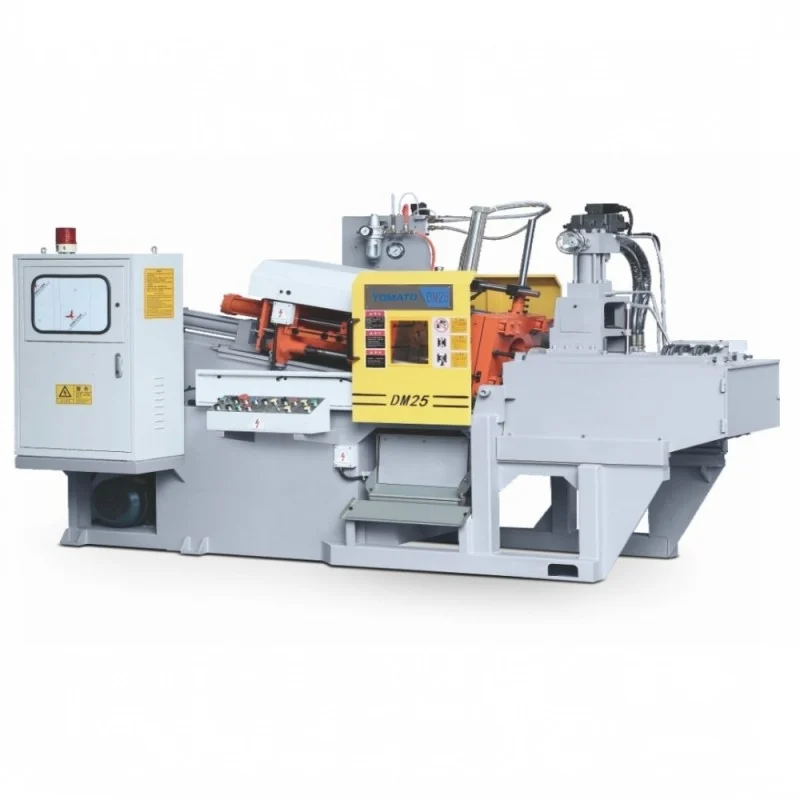
Review the HTJ examples below, explore the DM equipment package, or open the full machine directory. This is equipment supply for your production project, with installation and training assistance available within the agreed scope.
Hot Chamber Die Casting Machine Supply
Start with the information that matches your task. The HTJ specifications identify the force and mechanical envelope of particular machines. The DM configuration information explains the furnace, injection and mold controls, and optional systems around the machine.
Model names identify the product; the corresponding specification supplies its numerical values.
HTJ Mechanical Specifications at a Glance
These HTJ examples show how the mechanical fields vary across individual models. Clamping force is expressed in kN; the dimensional fields are in millimeters.
| Model | Clamping force (kN) | Tie-bar space H x V (mm) | Die height min/max (mm) | Moving-platen stroke (mm) |
|---|---|---|---|---|
| HTJ16 | 160 | 230 x 200 | 150/220 | 125 |
| HTJ58 | 580 | 311x311 | 120/320 | 210 |
| HTJ180 | 1800 | 480x480 | 200/580 | 385 |
Tie-bar space describes clearance between the bars. Die height and moving-platen stroke describe different aspects of the die and its movement. Read the fields together, rather than using a force value as a description of the entire machine. The pressure die casting machine directory contains the wider specification reference.
DM Furnace and Control Configuration
The DM series has a standard electric melting furnace. Fuel and natural-gas furnaces are available for special requirements. Its documented functions include two-stage injection control, multi-stage pressure control for mold opening and closing, and low-pressure mold-close protection.
Servo, air ejection, spraying and conveying systems are optional. That distinction matters when the new machine will work with equipment already on your floor. Explore the DM zinc machine configuration for the system-by-system scope, rather than assuming every peripheral is included.
Machine, Tool and Cell Context
A hot chamber machine supplies metal through its injection mechanism to the die. The tool closes for filling and opens after the casting has solidified; the casting is then ejected. NADCA’s hot-chamber process explanation describes this sequence.
Keep the metal-feed task, mold movement and part-handling task separate when defining the equipment boundary. A production project can retain an existing handling arrangement while changing the machine or its furnace configuration. Our hot-chamber process guide follows the cycle in more detail.
YOMATO and Project Support
YOMATO’s history begins in 1999, and its headquarters is in Changzhou, Jiangsu. For buyers comparing hot chamber die casting machine manufacturers, company identity and a clear equipment scope belong alongside the model data.
YOMATO can arrange technicians to assist with installation and trial running when necessary. Technical training is provided according to users’ needs. For a project discussion, bring the alloy, part and die information, existing equipment layout, furnace requirements and intended handling tasks into one brief. Send it to sales@hotchamberdiecasting.com so the machine and support discussion starts from the same scope.
Questions and answers
What is hot chamber die casting used for?
It is used for suitable low-melting-point alloys that do not readily attack the immersed metal-feed components. NADCA identifies zinc, magnesium, lead and other qualifying alloys as typical process materials. The selected alloy and the actual machine configuration must be considered together.
How does an HPDC machine work?
High-pressure die casting fills a closed die with molten metal, allows it to solidify, and releases the casting. In a hot-chamber arrangement, the plunger drives metal through the gooseneck and nozzle. The machine’s metal-feed and die-movement functions perform different parts of that cycle.
What is the difference between hot chamber and cold chamber die casting?
The main distinction is the metal-feed arrangement. The hot-chamber injection mechanism is immersed in the molten-metal bath. In the cold-chamber process described by NADCA, metal is ladled into a separate sleeve before the plunger injects it.