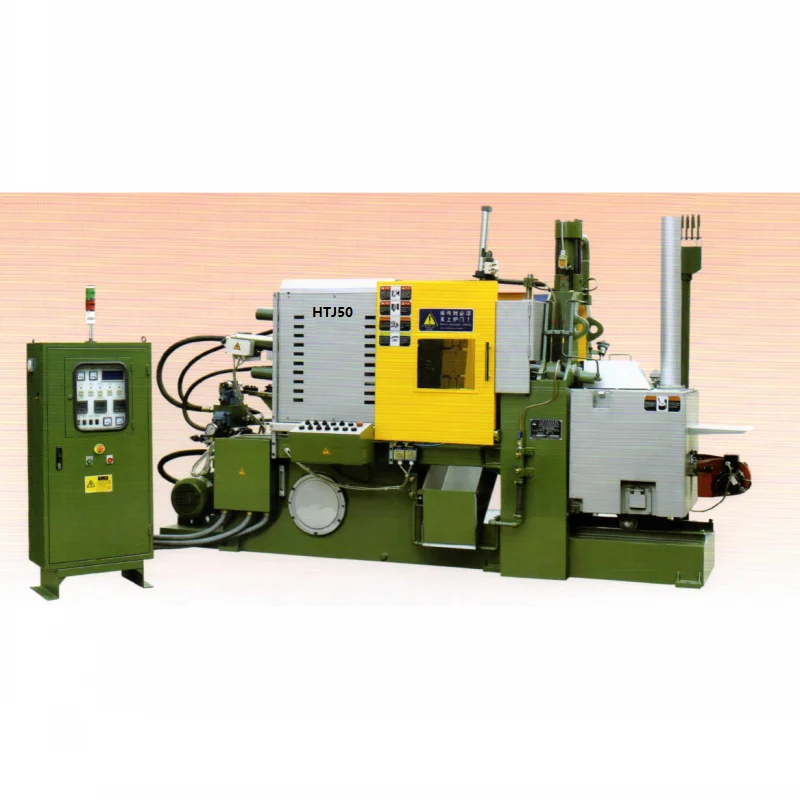
HTJ50 specifications
| Parameter | Unit | Value |
|---|---|---|
| Clamping force | kN | 500 |
| Moving Platen Stroke | mm | 210 |
| Space Between Tie Bar(HxV) | mm | 290x290 |
| Die Height(Min/Max) | mm | 120/320 |
| Injection Force | kN | 50 |
| Injection Stroke | mm | 110 |
| Injection Position | mm | 0,-40 |
| Ejecting Force | KN | 50 |
| Ejecting Stroke | mm | 50 |
| Shot sleeve diameter | mm | 50 |
| Working pressure of vane pump | MPa | 10.5 |
| Motor Power | kW | 9.5 |
| Dosage of fluid metal per shot(Zn) | kg | 1.1 |
| Effective Volume of Crucible (Zn) | kg | 160 |
| Burner oil consumption | kg/h | 1.5~6.0 |
| Oil Tank Capacity | L | 320 |
| Machine Weight | kg | 3500 |
| Machine Dimensions(LxWxH) | mm | 3500X1450x2100 |
Tooling and equipment configuration
For tooling review, the listed die-height entry is 120/320 mm. Compare the proposed closed die with that entry and the 290x290 mm tie-bar spacing. Also review how the die is mounted, how access is maintained and how the part is removed. A match on a single dimension is not a complete tooling review.
The moving platen stroke is listed as 210 mm. Include the required opening and removal arrangement in the enquiry, particularly when the casting, runner or handling equipment needs additional access. The table also lists ejecting force of 50 KN; describe the ejection arrangement instead of assuming that a force value defines the complete ejector layout.
Use the hot chamber process information to connect the die discussion with spraying, part removal and conveying. Specify which equipment belongs in the proposed supply and which existing equipment must remain. Interfaces and included items should be clear in the equipment proposal.
Injection and melting requirements
The HTJ50 table lists injection force of 50 kN and injection stroke of 110 mm. Keep these labels and units with the values when preparing a comparison. Injection force, stroke and the pump-pressure entry describe different parts of the machine record; they should not be treated as interchangeable figures.
For zinc, the published dosage-of-fluid-metal-per-shot entry is 1.1 kg, and the crucible entry is 160 kg. Identify the intended alloy and the complete casting arrangement in the enquiry. Ask the engineering team to review that project against the proposed injection and melting configuration; do not use the zinc-labelled entries as an automatic statement about another alloy.
The melting arrangement, controls and auxiliary equipment should be identified for the proposed HTJ configuration. Confirm these directly rather than assuming that a furnace or optional device described for the DM range is included with this model.
Installation and quotation scope
The listed machine dimensions are 3500X1450x2100 mm, and machine weight is 3500 kg. Share the available floor plan, access route and installation location when discussing the equipment. Review the machine outline together with space needed for die handling and the surrounding cell; the catalogue dimensions do not describe every site arrangement.
The motor-power entry is 9.5 kW. Request the complete utility requirements for the proposed machine and furnace, including any auxiliary equipment. A motor entry by itself is not a measured energy-consumption figure or a complete electrical supply schedule.
For project assistance, YOMATO's equipment support page explains the selection, testing, shipment, installation and training discussion. Confirm the applicable work, responsibilities and charges in the quotation. Keep a copy of the agreed specification and included-equipment list with the order.
Questions and answers
Which HTJ50 specifications should I check first?
Begin with clamping force (500 kN), tie-bar spacing (290x290 mm), die height (120/320 mm) and moving platen stroke (210 mm). Compare them with the actual tooling and removal requirements. Then review injection, ejection, melting and installation fields for the same configuration; selecting by the model number alone leaves those checks unanswered.
What affects the HTJ50 die casting machine price?
Ask for an itemised equipment quotation identifying the machine configuration, melting arrangement, required handling equipment, delivery destination and agreed support. State whether tooling or existing cell equipment is part of the project. Compare offers against that same scope; an equipment photograph or model name does not identify all the items included in a price.
How do I request a HTJ50 quotation?
Use the model enquiry form and include the alloy, drawing details, die dimensions, output requirement and installation country. Identify any existing equipment to be connected. Request the final HTJ50 specification, dimensional drawing, utility information and included-equipment list so your technical and purchasing teams can review the same proposal.